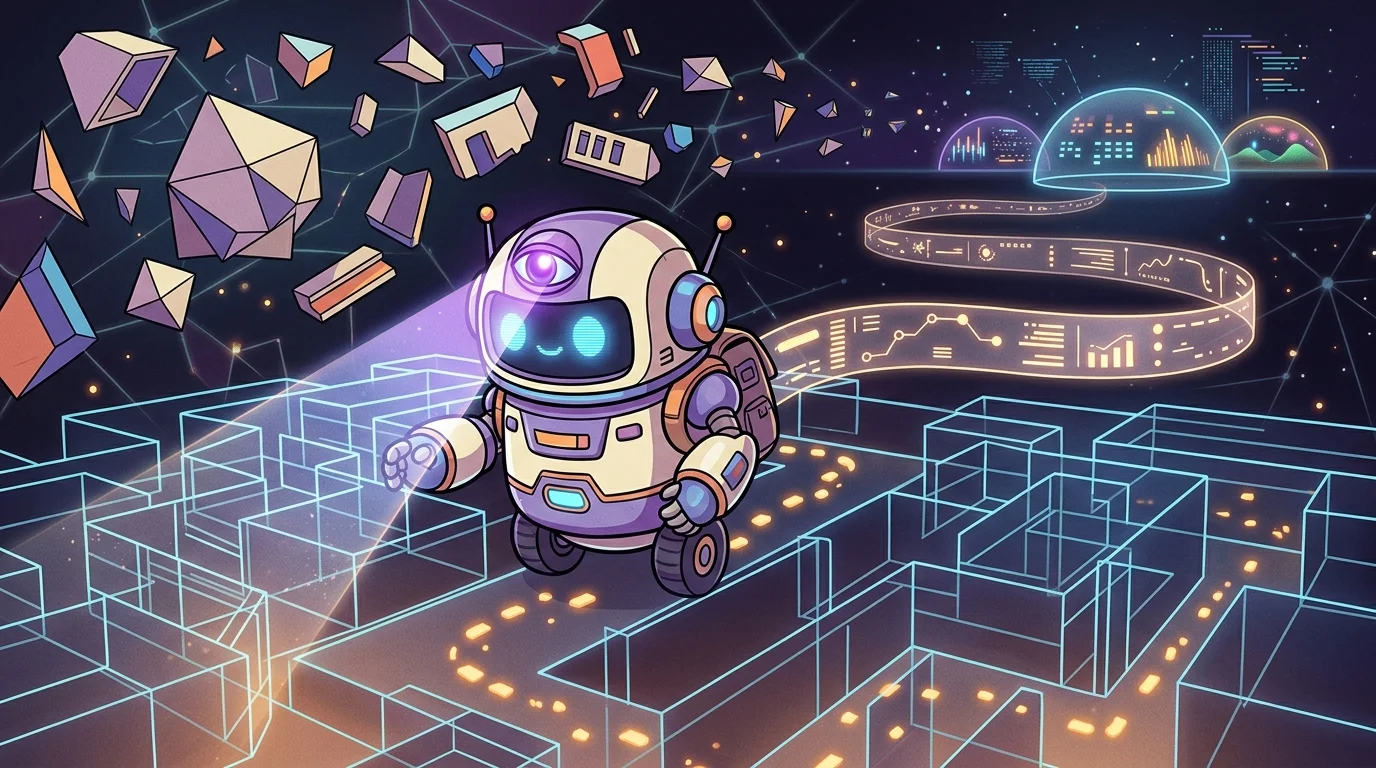
The Core Problem with Curiosity-Driven Exploration
Curiosity-driven reinforcement learning agents earn intrinsic rewards by measuring the gap between their predictive model of the world and observed reality. In simple environments, this signal reliably pushes agents toward novel states. In complex, photorealistic 3D environments, however, the approach breaks down in a specific way: agents become trapped in local loops, returning to previously visited states whose details have faded from the agent’s working memory and collecting fresh intrinsic rewards as though those states were new [1].
The result is a form of reward recycling. An agent that cannot remember where it has already been will treat a familiar corridor as unexplored territory, stalling the broader coverage that sparse-reward tasks require. Researchers studying this failure mode identified two structural deficits at its root: the absence of a persistent spatial record and the absence of trajectory-aware context in the policy itself [1].
Two Missing Ingredients: Spatial Persistence and Episodic Context
The paper’s central claim is that effective curiosity in 3D environments requires two components working together. First, the agent needs a world model that is persistent and continuously updated throughout an episode, so that already-explored regions remain represented and do not generate stale novelty signals. Second, the agent’s policy must maintain an episodic trajectory history, giving it the context to navigate toward genuinely novel regions rather than cycling back through familiar ones [1].
Neither ingredient alone is sufficient. A persistent world model without trajectory-aware memory still leaves the policy blind to its own recent path. Episodic memory without a spatial world model leaves the agent without a reliable map of what has been reconstructed. The combination addresses both failure modes simultaneously [1].
How the System Works
The researchers implement spatial persistence through online 3D reconstruction, which serves as the continuously updated world model. As the agent moves through an environment, the reconstruction accumulates geometric and visual information about visited regions, providing a persistent record that prevents already-seen areas from appearing novel [1].
Episodic context is handled by parameterizing the agent policy as a sequence model operating over RGB observations. Rather than acting on a single frame, the policy processes the agent’s history of visual inputs across the current episode, giving it the trajectory awareness needed to direct exploration toward unvisited areas. Critically, this design separates training-time structure from deployment-time requirements: the 3D reconstruction informs the curiosity signal and policy learning during training, but at deployment the agent navigates using only RGB frames, with no map input required [1].
Training Setup and Benchmark Results
The agent was trained purely via curiosity on the HM3D dataset, with no task-specific reward signal. Against RL-based active mapping baselines, the system outperforms competing approaches on exploration coverage [1].
Zero-shot transfer tests placed the trained agent in Gibson environments and in AI-generated worlds, neither of which appeared in training. The agent generalized to both without any fine-tuning or additional map inputs, demonstrating that the learned policy captures exploration behavior robust enough to transfer across environment distributions [1]. The combination of HM3D training and zero-shot transfer to Gibson and procedurally generated settings covers both established photorealistic benchmarks and synthetic domains relevant to simulation-based deployment pipelines.
Downstream Task Adaptation
Beyond pure exploration, the researchers evaluated whether the pretrained policy could be adapted efficiently to goal-directed tasks. Two downstream tasks served as test cases: apple picking and image-goal navigation. In both cases, the end-to-end policy adapted from the curiosity-trained checkpoint outperformed baselines trained from scratch on the same tasks [1].
This result suggests that the exploration pretraining instills broadly useful representations and navigation behaviors. Agents starting from the curiosity-trained policy reach competent performance on structured tasks faster than agents initialized without that prior, which has direct implications for how exploration pretraining might be positioned in agent development pipelines.
Implications for Agent Deployment
The RGB-only deployment requirement is a practical constraint with operational significance. Agents that require explicit map inputs at inference time depend on additional sensing infrastructure or preprocessing pipelines. This system’s ability to run on raw RGB frames removes that dependency, lowering the barrier to deployment in environments where structured map data is unavailable or expensive to produce [1].
Zero-shot generalization to both Gibson and AI-generated environments indicates that the policy is not narrowly fitted to HM3D’s visual statistics. For teams building agents intended to operate across photorealistic simulations or procedurally generated training worlds, that transferability reduces the need for environment-specific retraining. Video results from the research are available at the project site listed in the paper [1].
FAQ
Q. Does the agent require a 3D reconstruction module at deployment time? No. The online 3D reconstruction functions as the persistent world model during training and informs the curiosity signal, but at deployment the agent operates using only RGB frames with no map input required [1].
Q. Which environments were used for training versus evaluation? Training used the HM3D dataset exclusively, with no task-specific rewards. Zero-shot evaluation was conducted on Gibson environments and AI-generated worlds, neither of which appeared during training [1].
Q. How does this approach compare to active mapping baselines? The paper reports that the system outperforms RL-based active mapping baselines on exploration, though specific numeric margins are not detailed in the available source [1].
Q. Can the pretrained policy be adapted to task-specific goals? Yes. The end-to-end policy was adapted to apple picking and image-goal navigation, outperforming from-scratch baselines on both tasks, suggesting the exploration pretraining transfers to downstream goal-directed behavior [1].
Q. What is the sequence model operating over during the episode? The policy is parameterized as a sequence model over RGB observations accumulated during the current episode, giving the agent episodic trajectory history rather than acting on a single frame [1].
Key takeaways
- Curiosity-driven agents fail in 3D environments primarily because they lack spatial persistence and episodic context, causing them to re-earn rewards for revisiting forgotten states [1].
- Online 3D reconstruction provides the persistent world model; a sequence-model policy over RGB observations provides the episodic context [1].
- Training on HM3D with pure curiosity rewards produces a policy that generalizes zero-shot to Gibson and AI-generated environments without map inputs at deployment [1].
- The pretrained policy adapts to downstream tasks including apple picking and image-goal navigation, outperforming from-scratch baselines in both cases [1].
- RGB-only deployment removes dependence on external map infrastructure, broadening the range of environments where the agent can be applied [1].