The Gap LAP Fills
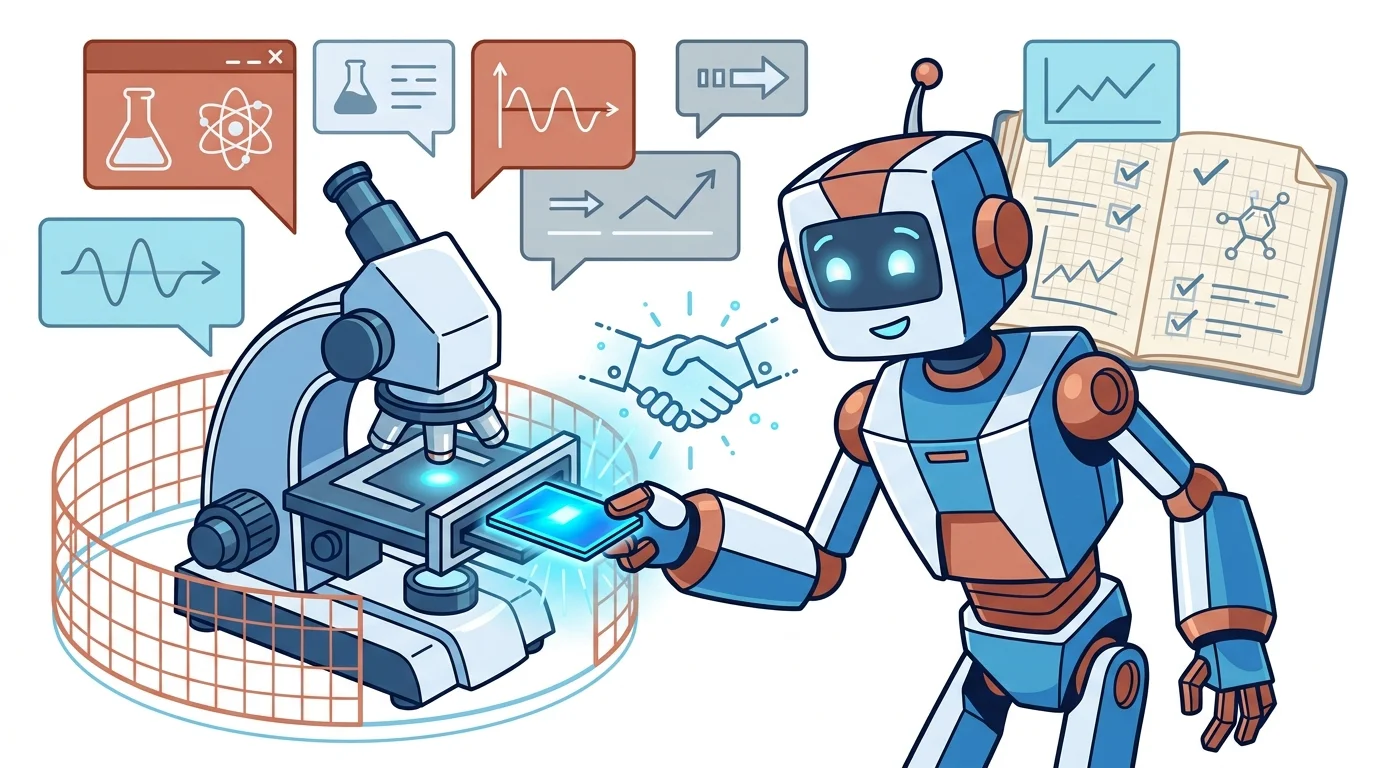
Existing agent-interoperability protocols address two of the three communication edges in an agentic ecosystem. Anthropic’s Model Context Protocol standardizes the agent-to-tool edge, and Google’s Agent2Agent protocol standardizes the agent-to-agent edge. Neither protocol models the agent-to-instrument edge, where operations are stateful, safety-critical, exclusively owned, physically embodied, and produce measurements with units, calibration, and uncertainty [20].
That gap matters in practice because physical laboratory instruments impose constraints that software tools do not. A spectrometer or liquid-handling robot can be occupied by only one process at a time, its operations may be irreversible, and its outputs carry physical meaning that requires unit typing and uncertainty quantification to be scientifically valid. Existing device standards such as SiLA 2 and OPC-UA were designed for deterministic software clients, not for probabilistic, goal-directed agents [20]. Every self-driving laboratory system built to date has therefore reconstructed this communication layer from scratch, against fragmented vendor SDKs.
Protocol Architecture
LAP retains the peer-to-peer, discovery-first, task-lifecycle structure of Google’s Agent2Agent protocol and layers four physical-world primitives on top of it [20]. The protocol specifies roles, a six-layer architecture, a JSON-RPC method set, task and safety state machines, an error model, and cross-laboratory federation. It is transport-compatible with the A2A and Model Context Protocol ecosystem, meaning teams already operating within those interoperability layers do not need to replace their existing infrastructure to adopt LAP.
The protocol also encapsulates rather than replaces existing device standards. SiLA 2 and OPC-UA integrations can sit beneath LAP, which acts as the agent-facing interface layer above them [20]. That design choice is significant for adoption: instrument vendors with existing SDK investments can expose a LAP-compliant interface without discarding lower-level driver code.
Key Technical Primitives
LAP introduces four primitives that distinguish it from general-purpose agent protocols.
The InstrumentCard is a signed capability and physical-limit description. It functions as the discovery artifact in LAP’s discovery-first architecture, giving an agent a verifiable, machine-readable summary of what an instrument can do and what physical boundaries it must not exceed [20].
Reservation and exclusive locking provide first-class support for the single-occupancy constraint of physical instruments. An agent acquires an exclusive lock on an instrument and, where applicable, on the sample loaded into it, before issuing any commands. This prevents concurrent access conflicts that would be benign in software tool contexts but potentially destructive in physical ones [20].
The safety-fence handshake introduces operator-confirmation tokens that are cryptographically bound to a specific task and its parameters. Hazardous or irreversible operations cannot proceed until a valid token is presented, gating execution at the protocol level rather than relying on application-layer checks [20].
The MeasurementResult schema makes every result physically typed using QUDT and UCUM unit vocabularies. Each result is calibration-anchored, uncertainty-bearing, and reproducible by construction [20]. For operators integrating LAP outputs into downstream analysis pipelines, this means unit and uncertainty metadata travel with the measurement rather than being reconstructed or assumed after the fact.
Safety and Irreversibility Handling
The cryptographic binding of confirmation tokens to specific tasks and parameters is the central mechanism by which LAP gates hazardous operations. A token issued for one task cannot be replayed against a different task or a modified parameter set, because the binding is specific [20]. This design addresses a practical concern in autonomous laboratory settings: an agent that has been authorized to perform one procedure should not be able to reuse that authorization for a structurally similar but distinct operation.
In practice, the operator-confirmation flow requires a human or a designated supervisory system to issue a token after reviewing the task and its parameters. The instrument driver will not execute the operation until the token is presented and validated against the bound task record. The protocol’s safety state machine tracks this confirmation state as a first-class transition, not as an optional annotation [20].
Target Deployments and Self-Driving Lab Context
LAP is designed for autonomous-science and self-driving laboratory scenarios in which large language model agents plan experiments and robotic or automated instruments execute them [20]. The researchers frame the broader context as a shift from demonstration to infrastructure: autonomous science systems have moved past proof-of-concept stages and now require standardized communication layers to operate reliably at scale.
The protocol includes a specification of cross-laboratory federation, which addresses scenarios where a campaign spans instruments at multiple physical sites. A worked example in the paper walks a closed-loop autonomous campaign through the protocol end-to-end, illustrating how the primitives compose across the full experiment lifecycle [20].
For operators evaluating adoption, the practical change is that the agent-to-instrument integration becomes a protocol compliance problem rather than a bespoke engineering problem. Teams currently maintaining custom glue code between reasoning agents and instrument drivers would replace that layer with a LAP-compliant interface, gaining the reservation, safety-fence, and measurement-typing guarantees as part of the protocol contract.
Open Questions and Adoption Path
The paper identifies several unresolved areas. Vendor SDK integration remains an open engineering problem: while LAP encapsulates existing device standards, the work of wrapping specific vendor SDKs in LAP-compliant instrument drivers falls to implementers [20]. The protocol design does not prescribe how that wrapping should be done for any particular instrument family.
The mismatch between probabilistic agent clients and the deterministic assumptions embedded in existing device standards is noted as a structural challenge. SiLA 2 and OPC-UA were not designed to accommodate clients that may issue ambiguous or context-dependent commands, and LAP’s role as an intermediary layer does not fully resolve that mismatch at the driver level [20].
The path toward formal standardization is not specified in the current publication. LAP is presented as a protocol design, and the paper does not describe a standards-body submission process or an open governance structure for the specification.
FAQ
Q. Does adopting LAP require replacing existing instrument drivers built on SiLA 2 or OPC-UA? No. LAP encapsulates rather than replaces existing device standards such as SiLA 2 and OPC-UA, acting as the agent-facing interface layer above them [20]. Existing lower-level driver code can remain in place beneath a LAP-compliant wrapper.
Q. How does the safety-fence handshake prevent token reuse across different operations? Confirmation tokens are cryptographically bound to a specific task and its parameters, so a token issued for one operation cannot be replayed against a different task or a modified parameter set [20]. The protocol’s safety state machine tracks confirmation state as a first-class transition.
Q. What unit and uncertainty standards does the MeasurementResult schema use? The schema uses QUDT and UCUM vocabularies for physical unit typing, and each result is required to carry calibration and uncertainty fields by construction [20]. This means downstream analysis pipelines receive unit and uncertainty metadata with every measurement rather than needing to reconstruct it.
Q. Is LAP compatible with teams already using Model Context Protocol or Agent2Agent infrastructure? Yes. LAP is described as transport-compatible with the A2A and Model Context Protocol ecosystem [20], so teams operating within those interoperability layers can add LAP at the instrument edge without replacing existing agent-to-tool or agent-to-agent integrations.
Q. What remains unresolved for teams considering early adoption? Vendor SDK wrapping is left to implementers, and the mismatch between probabilistic agent clients and the deterministic assumptions of existing device standards is acknowledged but not fully resolved at the driver level [20]. No formal standardization process or open governance structure for the specification is described in the current publication.
Key takeaways
- LAP fills the agent-to-instrument edge left unaddressed by Anthropic’s Model Context Protocol and Google’s Agent2Agent protocol, targeting stateful, safety-critical, physically embodied instrument interactions [20].
- Four primitives distinguish LAP from general-purpose protocols: the signed InstrumentCard, exclusive reservation locking, a cryptographic safety-fence handshake with operator-confirmation tokens, and a physically typed MeasurementResult schema with QUDT/UCUM units and uncertainty fields [20].
- Confirmation tokens are cryptographically bound to specific tasks and parameters, preventing reuse across different operations and gating hazardous or irreversible actions at the protocol level [20].
- LAP encapsulates SiLA 2 and OPC-UA rather than replacing them, and is transport-compatible with the existing A2A and Model Context Protocol ecosystem, lowering the integration barrier for teams with existing infrastructure [20].
- Vendor SDK wrapping, probabilistic-client compatibility at the driver level, and a path to formal standardization remain open questions in the current protocol design [20].