The Problem With Flat-Chunk RAG
Conventional retrieval-augmented generation systems organize external knowledge as flat text chunks and retrieve them by embedding similarity. That design works adequately for single-turn lookups, but it creates structural friction for tool-using LLM agents that must search, read, traverse, and decide iteratively when evidence is sufficient [10].
The mismatch is architectural. Embedding-similarity retrieval exposes what the LLM-Wiki paper calls a “retrieval-as-lookup” interface: the agent issues a query, receives a ranked list of chunks, and must reason over disconnected fragments with no built-in mechanism for following relationships between documents [10]. Research on citation-graph retrieval has separately quantified a related failure mode, finding that cosine similarity retrievers return off-agenda results in roughly 8 of every 10 cases on research-agenda queries, a gap that structured graph signals can partially close [3]. For agents that require multi-hop reasoning across related documents, flat-chunk organization compounds these precision problems at every retrieval step.
The AuthTrace diagnostic benchmark, which places chunk retrieval, agent memory, knowledge-graph traversal, and thematic indexing on a single corpus and query set, provides additional evidence of the problem. Its findings show that flat retrieval degrades approximately three times faster than structured-evidence systems as query fan-in increases, and that evidence recall rather than precision is the dominant predictor of answer quality [12].
What LLM-Wiki Is
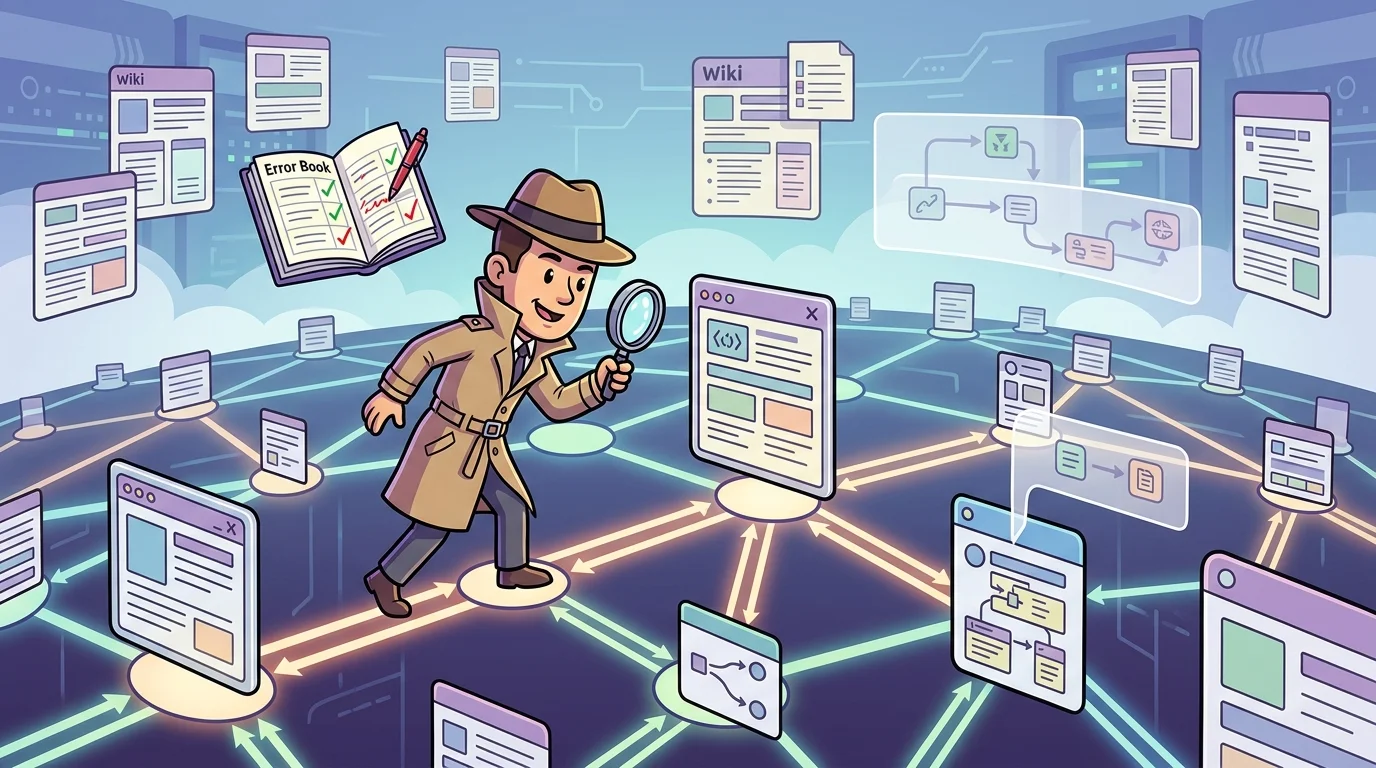
LLM-Wiki is an agent-native retrieval system that operationalizes what its authors call the Retrieval-as-Reasoning paradigm. Rather than treating external knowledge as a static retrieval index, the system compiles documents into structured Wiki pages with bidirectional links, creating a composable and self-evolving knowledge structure [10].
The core design premise is that retrieval for agents should behave less like one-shot context fetching and more like reasoning: the agent searches, reads, traverses links, and decides when it has gathered sufficient evidence. LLM-Wiki encodes that reasoning loop into the structure of the knowledge base itself, rather than leaving it entirely to the agent’s in-context behavior [10].
How the System Works
LLM-Wiki exposes three operations through standard tool-calling interfaces: search, read, and link-following. These map directly onto the iterative steps an agent takes when working through a multi-hop question, allowing the agent to navigate the compiled Wiki structure using the same tool-calling mechanisms it uses for other tasks [10].
The compilation pipeline transforms source documents into structured Wiki pages. Bidirectional links between pages encode relationships that would otherwise be invisible to a flat-chunk retriever, enabling the link-following operation to traverse related evidence without requiring a new embedding query at each step [10].
The system also introduces an Error Book mechanism for persistent self-correction. The Error Book accumulates records of structural and semantic errors encountered during retrieval and reasoning, allowing the system to correct those errors across subsequent operations rather than repeating them. This self-evolving property distinguishes LLM-Wiki from static graph-based retrieval systems that require manual curation or full recompilation to address errors [10].
Benchmark Results
On three standard multi-hop question-answering benchmarks, HotpotQA, MuSiQue, and 2WikiMultiHopQA, LLM-Wiki outperforms seven baselines. The baselines include HippoRAG 2, LightRAG, GraphRAG, and Dense RAG. Against the strongest graph-based baseline, LLM-Wiki achieves gains of 2.0 to 8.1 F1 points, with larger gains over Dense RAG [10].
On AuthTrace, which was designed specifically to diagnose evidence construction systems across paradigms using a single corpus and query set [12], LLM-Wiki achieves the best overall accuracy. The gains are described as especially strong on multi-document structured queries, a result the authors interpret as evidence that compilation-based knowledge organization generalizes beyond chain-style multi-hop reasoning [10].
Where This Fits in the Broader RAG Landscape
LLM-Wiki enters a field where several research groups are independently converging on structured state management as the answer to flat-chunk RAG’s limitations. EfficientGraph-RAG, a contemporaneous system, defines retrieval state explicitly through typed hierarchical evidence spaces and role-specialized agents for state verification, and reports matching the strongest agentic baseline on HotpotQA while reducing large-model token usage by 3.51 times [13]. The two systems share a diagnosis but differ in mechanism: EfficientGraph-RAG emphasizes state management and reuse across queries, while LLM-Wiki emphasizes compiled knowledge structure and agent-native tool interfaces.
AuthTrace itself is a relevant artifact in this landscape. By placing all major retrieval paradigms on a single corpus with exhaustive gold evidence and a fan-in gradient as the primary diagnostic axis, it enables the kind of cross-paradigm comparison that previously required incompatible benchmarks and corpora [12]. LLM-Wiki’s strong AuthTrace results are therefore meaningful beyond the numbers: they reflect performance on a benchmark designed to expose paradigm-specific collapse patterns.
The broader direction, treating retrieval as a structured reasoning process rather than a similarity lookup, also connects to work on typed memory representations for long-term agents. MemIR, for example, separates raw evidence, retrieval cues, and truth-bearing claims into grounded atoms to prevent source-monitoring errors in persistent agents [7]. The common thread is that unstructured, flat storage creates failure modes that structured organization can address at the architectural level.
Implications for Agent Retrieval Engineering
For practitioners building retrieval pipelines for multi-hop and multi-document agent workflows, LLM-Wiki’s compilation-based approach represents a meaningful architectural shift. The system requires a compilation step that transforms source documents into Wiki pages before retrieval can begin, which introduces an upfront cost absent from flat-chunk RAG pipelines that index documents directly.
In return, the compiled structure exposes link-following as a first-class operation, reducing the number of embedding queries an agent must issue to traverse related evidence. The Error Book mechanism offers a path toward retrieval quality that improves over time without full recompilation, which is relevant for corpora that accumulate errors through automated ingestion [10].
The benchmark evidence suggests the gains are most pronounced on multi-document structured queries and on tasks where evidence recall drives answer quality [10, 12]. Teams working on single-document or single-hop retrieval may see smaller returns from the compilation overhead. For those building agents that must reason across large, interlinked document collections, the structured Wiki representation addresses a documented failure mode in flat-chunk systems at the cost of a more complex ingestion pipeline.
FAQ
Q. Does LLM-Wiki require replacing an existing embedding-based index entirely? Based on the source, LLM-Wiki compiles documents into structured Wiki pages with bidirectional links and exposes search, read, and link-following operations through tool-calling interfaces [10]. The paper does not describe a hybrid mode that preserves an existing flat-chunk index alongside the Wiki structure.
Q. How does the Error Book handle errors that recur across different document types? The source describes the Error Book as a mechanism for persistent structural and semantic self-correction, but does not detail how it distinguishes or categorizes errors by document type [10]. Practitioners would need to consult the full paper for implementation specifics.
Q. How does LLM-Wiki compare to EfficientGraph-RAG on shared benchmarks? LLM-Wiki reports gains of 2.0 to 8.1 F1 points over the strongest graph-based baseline on HotpotQA, MuSiQue, and 2WikiMultiHopQA [10]. EfficientGraph-RAG reports matching the strongest agentic baseline on HotpotQA EM while reducing token usage [13]. The two papers do not report a direct head-to-head comparison using identical experimental conditions.
Q. Is AuthTrace a fair benchmark for evaluating LLM-Wiki given that LLM-Wiki is one of the systems tested on it? AuthTrace was designed as a diagnostic benchmark that places all major retrieval paradigms on a single corpus and query set, with 2,099 instances and exhaustive gold evidence [12]. It was not built specifically for LLM-Wiki, and the benchmark paper reports results across eight systems, providing a cross-paradigm comparison rather than a benchmark tailored to any single system.
Q. What corpus types are best suited to LLM-Wiki’s compilation pipeline? The source indicates that LLM-Wiki’s strongest gains appear on multi-document structured queries and that its compilation-based knowledge organization generalizes beyond chain-style multi-hop reasoning [10]. The paper does not specify corpus size limits or document type restrictions for the compilation pipeline.
Key takeaways
- LLM-Wiki compiles source documents into structured Wiki pages with bidirectional links and exposes search, read, and link-following operations through standard tool-calling interfaces, replacing embedding-similarity lookup with a reasoning-oriented retrieval model [10].
- On HotpotQA, MuSiQue, and 2WikiMultiHopQA, LLM-Wiki outperforms seven baselines including HippoRAG 2, LightRAG, GraphRAG, and Dense RAG, with gains of 2.0 to 8.1 F1 points over the strongest graph-based baseline [10].
- The Error Book mechanism enables persistent self-correction of structural and semantic errors without requiring full recompilation of the knowledge base [10].
- AuthTrace benchmark results show LLM-Wiki achieves best overall accuracy with especially strong performance on multi-document structured queries, suggesting the approach generalizes beyond chain-style multi-hop tasks [10, 12].
- Compilation-based knowledge organization introduces upfront ingestion cost but reduces per-query embedding overhead through link-following, a trade-off most relevant for agents working across large, interlinked document collections [10].