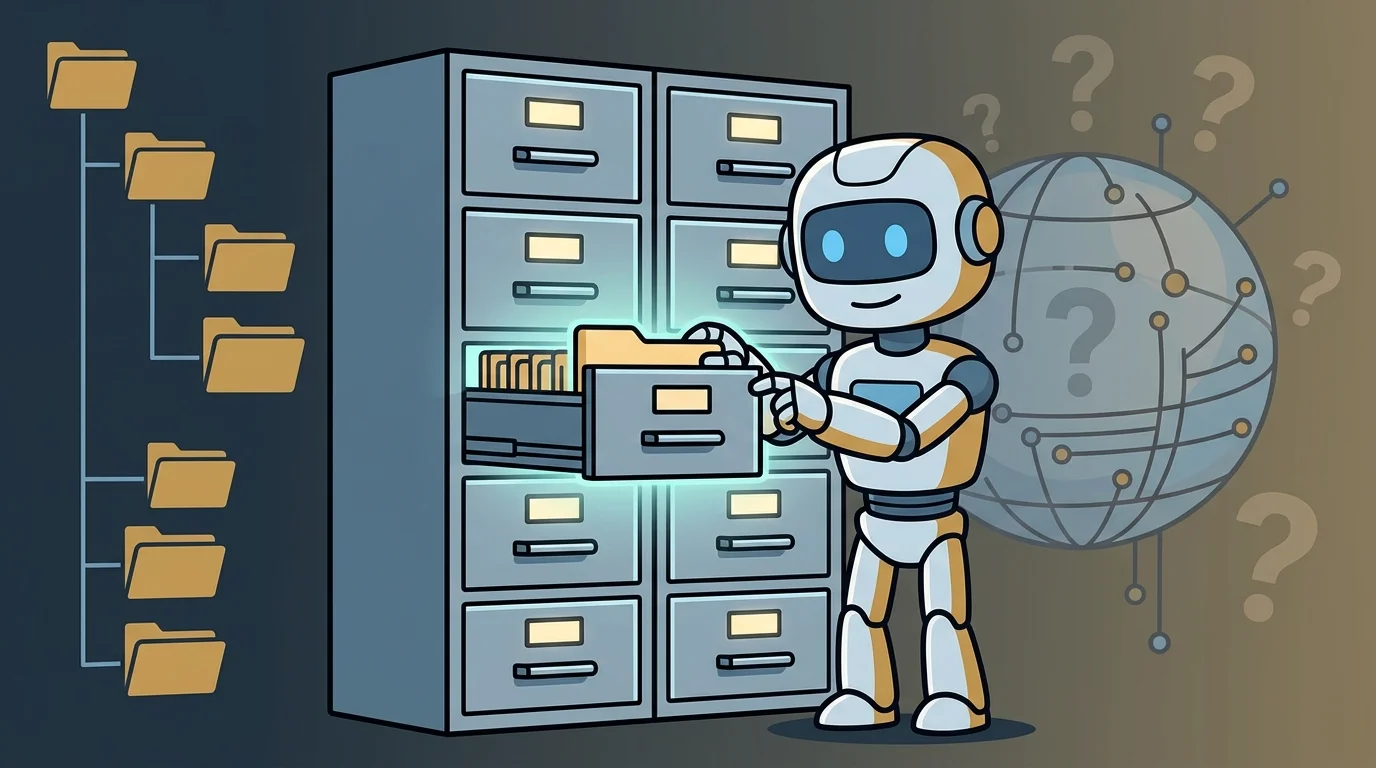
The Problem OpenViking Targets
Developers building AI agents routinely encounter five context management problems that the OpenViking project identifies as its primary motivation [1].
First, context is fragmented: memories live in application code, resources sit in vector databases, and skills are scattered across separate systems with no uniform management layer. Second, long-running agent tasks generate context continuously at every execution step, and simple truncation or compression causes information loss as demand surges. Third, traditional RAG relies on flat storage that lacks a global view of information, making it difficult to understand the full context behind any retrieved chunk. Fourth, the implicit retrieval chain in traditional RAG operates as a black box, offering little visibility when errors occur and making debugging difficult. Fifth, current memory implementations record only user interactions and do not capture agent-related task memory, limiting how memory can evolve over time [1].
What OpenViking Is
OpenViking is an open-source context database built specifically for AI agents, released by Volcengine [1]. The project aims to define what it describes as a minimalist context interaction paradigm, allowing developers to move away from fragmented vector storage. Rather than treating memories, resources, and skills as separate concerns stored in different systems, OpenViking consolidates them into a single structured layer organized around a file system paradigm [1].
The repository notes explicit compatibility with agent systems such as openclaw [1].
How the File System Paradigm Works
The file system paradigm is the central architectural departure from traditional RAG. Instead of flat vector storage, OpenViking structures agent context the way a local file system organizes files and directories, giving developers a familiar management model for memories, resources, and skills [1].
Retrieval under this model combines directory positioning with semantic search, a method the project calls directory recursive retrieval. This approach is intended to improve retrieval effectiveness by providing a global view of stored context rather than the isolated chunk lookups characteristic of flat vector databases [1].
The system also introduces a tiered context loading structure with three levels: L0, L1, and L2. Context is loaded on demand across these tiers, which the project states significantly reduces token consumption and associated costs compared to loading all context uniformly [1].
The observable retrieval chain is another stated differentiator. By making the retrieval path explicit rather than implicit, OpenViking aims to give developers the ability to inspect and debug context decisions during agent execution [1].
Benchmark Results and Evaluation
In May 2026, Volcengine updated OpenViking’s benchmark results covering three evaluation scenarios: User Memory, Agent Memory, and Knowledge Base QA [1]. The repository directs readers to an Evaluation Highlights section for the specific figures, though the source does not reproduce the numerical results in the available excerpt.
Who the Project Is Built For
OpenViking targets developers building AI agents who need structured, observable, and iterable context management. The project is positioned as a replacement for ad hoc combinations of vector databases, in-code memory, and scattered skill storage [1]. Compatibility with openclaw is noted directly in the repository description, indicating the project is designed to integrate with existing agent frameworks rather than operate as a standalone system [1].
Because the project is open-source and hosted on GitHub under the Volcengine organization, developers can inspect the implementation, contribute, and adapt the file system paradigm to their own agent architectures [1].
FAQ
Q. Does OpenViking replace a vector database entirely, or does it layer on top of one? The project states it abandons the fragmented vector storage model of traditional RAG in favor of the file system paradigm, but the available source does not detail whether an underlying vector store is used internally [1].
Q. What agent frameworks does OpenViking support beyond openclaw? The repository names openclaw as a compatible agent system. No other specific framework integrations are listed in the available source material [1].
Q. How does tiered context loading affect existing agent workflows? The L0/L1/L2 structure loads context on demand, which the project states reduces token consumption. The source does not describe a specific migration path from existing RAG pipelines [1].
Q. Are the May 2026 benchmark numbers publicly available? The repository references updated benchmark results across User Memory, Agent Memory, and Knowledge Base QA scenarios and points to an Evaluation Highlights section, but the numerical results are not reproduced in the available source excerpt [1].
Q. Is the retrieval chain fully inspectable at runtime? OpenViking explicitly targets the black-box nature of traditional RAG retrieval as a pain point and states that its retrieval chain is observable, though the source does not specify the tooling or interface used to expose that chain [1].
Key Takeaways
- OpenViking is an open-source context database from Volcengine that replaces flat RAG vector storage with a file system paradigm for unified agent context management [1].
- The system consolidates memories, resources, and skills into a single structured layer, addressing fragmentation that commonly affects long-running agent tasks [1].
- A three-tier (L0/L1/L2) on-demand loading model is intended to reduce token consumption compared to uniform context loading [1].
- Directory recursive retrieval combines directory positioning with semantic search to improve retrieval effectiveness over flat vector lookups [1].
- Benchmark results covering User Memory, Agent Memory, and Knowledge Base QA scenarios were updated in May 2026, with compatibility noted for the openclaw agent system [1].