What Boxes.dev Is
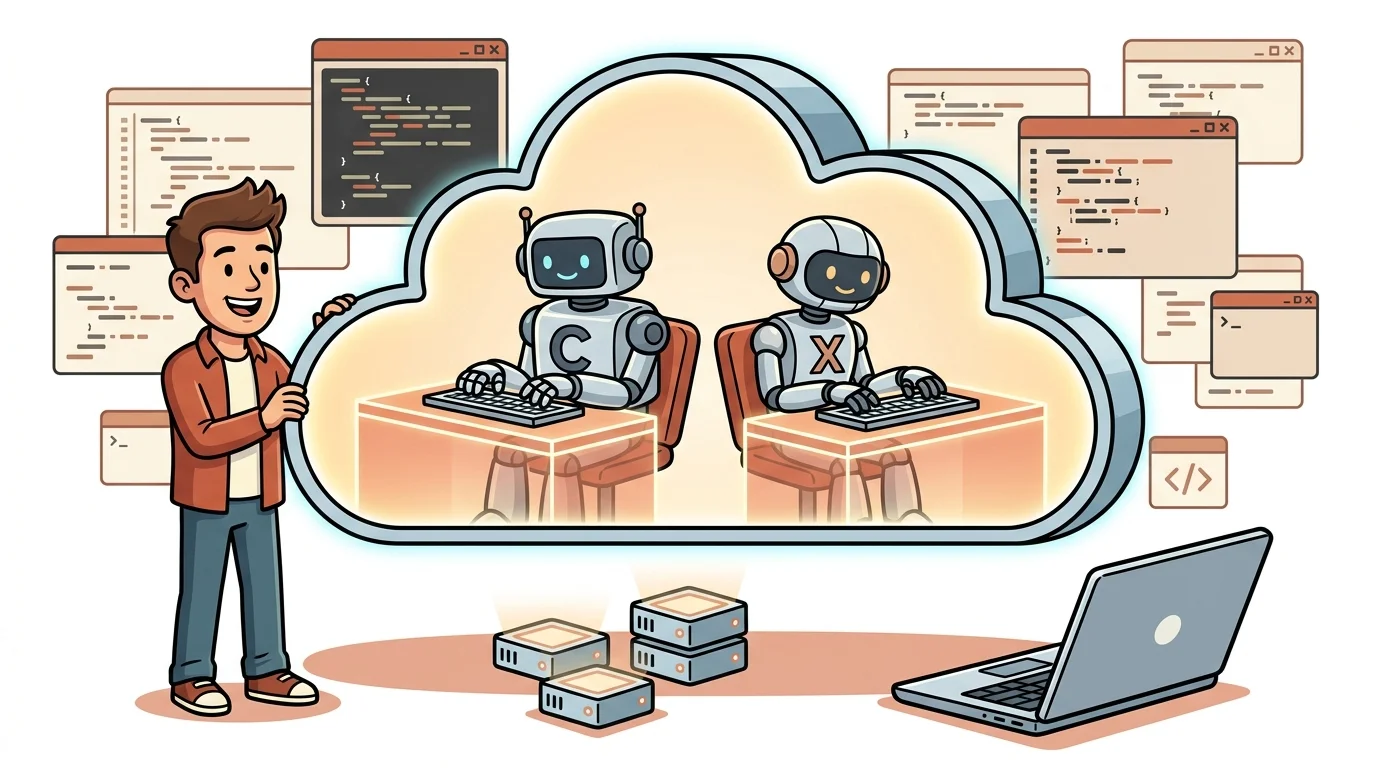
Boxes.dev is a cloud-only agentic development environment (ADE) built by engineers Nick and Drew, the team previously behind Gem. The product runs Anthropic Claude Code and OpenAI Codex agents on remote compute rather than on a developer’s local machine, giving each agent its own isolated cloud computer [1]. The founders position it against local-machine alternatives such as Conductor and the Codex desktop app, with the distinguishing characteristic that all compute lives in the cloud rather than on-premises [1].
The Problem It Addresses
Nick and Drew spent roughly a year coding almost exclusively with Codex and Anthropic Claude Code before concluding that localhost was limiting their workflow. Three pain points drove the decision to build Boxes.dev. First, running multiple parallel agents that each test their own work by spinning up the full application locally created resource contention on laptop hardware [1]. Second, Git worktrees, the conventional workaround for parallelizing agent work across branches, were described by the founders as clunky to configure and operate [1]. Third, mobile access to active agent sessions was treated as an afterthought in existing tooling, even as the nature of coding interactions shifted toward conversational input [1].
How It Works
Onboarding centers on an automated migration step: coding agents scan a developer’s existing local setup and port that configuration to cloud compute [1]. Once the environment is replicated, every new Anthropic Claude Code or Codex thread starts from a snapshot of that full setup, with its own filesystem and dedicated compute allocation. Developers use their existing Claude Code or Codex subscriptions within the environment rather than purchasing separate compute credentials for the agents themselves [1].
Key Technical Capabilities
Each agent thread receives an isolated cloud computer, which allows parallel agents to run and test full application stacks simultaneously without competing for the same CPU, memory, or disk resources [1]. The product ships as both a desktop and a mobile app. The mobile client is described as fully featured, with no handoffs or remote-control workarounds required [1]. Additional capabilities listed at launch include scheduled automations and a Slack integration. The founders note that the Anthropic Claude Code and Codex user experience has been mirrored inside Boxes.dev to feel familiar to power users already accustomed to those interfaces [1].
Who It Targets
The intended users are developers who already rely heavily on Anthropic Claude Code or Codex and have begun hitting the practical ceiling of single-machine execution. Specifically, the product addresses teams or individuals running multiple concurrent agent threads that each need to exercise a full application stack during testing, a workload that strains laptop hardware and requires manual Git worktree management under the current local-first model [1].
Early Status and Open Questions
Boxes.dev launched via a Show HN post, indicating an early public debut rather than a mature commercial release [1]. The source material does not specify pricing tiers, the underlying cloud infrastructure provider, or compute specifications for the per-agent environments. Details about data residency, security isolation between tenants, and how the environment-scanning migration handles complex monorepo or polyrepo configurations are not addressed in available materials.
FAQ
Q. Do developers need separate API keys or compute accounts to use Boxes.dev? According to the founders, developers use their existing Claude Code or Codex subscriptions directly within the environment, so no separate compute credentials are required for the agents [1].
Q. How does the cloud migration handle an existing local dev setup? Coding agents scan the developer’s local configuration and port it to cloud compute, after which each agent thread starts from a snapshot of that replicated environment with its own filesystem [1]. The source material does not detail how edge cases such as proprietary local dependencies or complex build systems are handled.
Q. Is the mobile app a remote-control interface or a native client? The founders describe it as a fully featured mobile app with no handoffs or remote-control mechanisms, though no further technical detail about its implementation is available in current source materials [1].
Q. How does Boxes.dev differ from Conductor or the Codex desktop app? The primary distinction stated by the founders is that Boxes.dev runs everything in the cloud, whereas Conductor and the Codex desktop app operate on local machines [1]. No independent benchmarks or feature comparisons are available from the source material.
Q. What scheduling and integration features are available at launch? The product includes scheduled automations and a Slack integration at the time of the Show HN launch [1]. No additional detail about the scope or configuration of these features appears in available sources.
Key takeaways
- Boxes.dev provides per-agent isolated cloud computers for Anthropic Claude Code and OpenAI Codex, eliminating local resource contention during parallel agent workloads [1].
- An automated onboarding flow uses coding agents to scan and replicate a developer’s local environment to cloud compute, with each agent thread starting from a full-stack snapshot [1].
- Developers use their existing Claude Code or Codex subscriptions inside the environment rather than provisioning separate cloud credentials [1].
- The product ships with desktop and mobile apps, scheduled automations, and a Slack integration at its Show HN launch stage [1].
- Pricing, infrastructure provider details, and security isolation specifics are not disclosed in current source materials.