What Changed in v0.6.0
Microsoft released AutoGen Python v0.6.0 with a targeted but consequential API change to BaseGroupChatManager. The select_speaker method, which previously returned a single string representing one agent name, now returns either a string or a list of strings [1]. The updated type hint reads List[str] | str, replacing the original str-only return type.
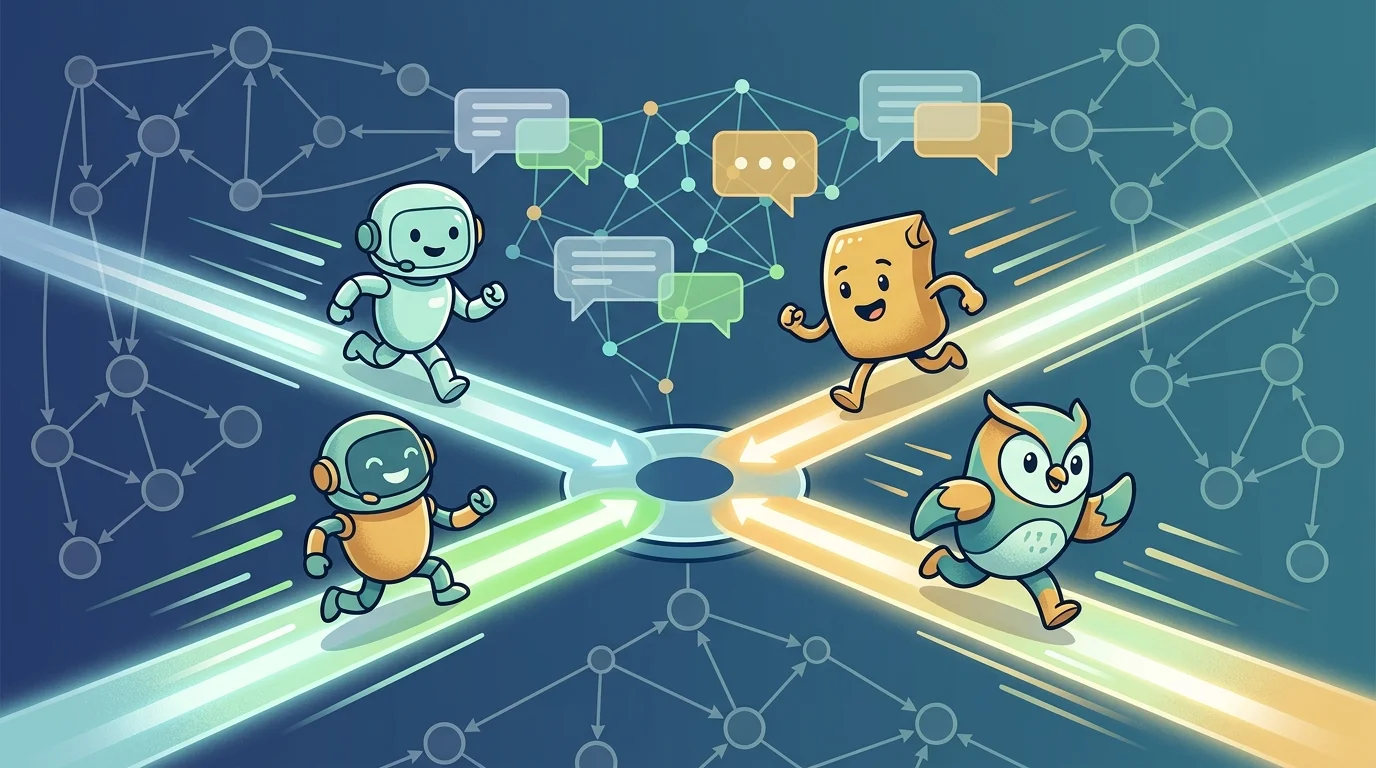
The change addresses a structural limitation in GraphFlow: prior to this release, the execution model could only activate one agent at a time per selection step. Returning a list of agent names unlocks parallel activation, enabling workflows where multiple agents run simultaneously within a single graph traversal step [1].
How Concurrent Agents Work in GraphFlow
GraphFlow organizes agent execution as a directed graph. Operators use DiGraphBuilder to define nodes (agents) and edges (execution dependencies) between them. When select_speaker returns a list, GraphFlow treats those agents as concurrent participants for that step, running them in parallel before converging results downstream [1].
This is the fan-out-fan-in pattern. A single upstream agent produces output, which fans out to multiple downstream agents executing concurrently. Their outputs then fan back in to a subsequent stage. The pattern is common in pipelines that require parallel processing, such as running multiple transformations or analyses on the same input simultaneously.
Code-Level Details
The sample code shipped with v0.6.0 illustrates the pattern directly. Three AssistantAgent instances are initialized using OpenAIChatCompletionClient with the gpt-4.1-nano model. Agent A acts as a general assistant, Agent B translates input to Chinese, and Agent C translates input to Japanese [1].
DiGraphBuilder wires the graph: Agent A is connected to both Agent B and Agent C via add_edge calls, creating a fan-out from A to the pair. The resulting graph object is passed to GraphFlow along with the participant list and a MaxMessageTermination condition set to five messages [1].
The original and new method signatures side by side show the scope of the change:
# Original signature:
async def select_speaker(self, thread: Sequence[BaseAgentEvent | BaseChatMessage]) -> str:
    ...

# New signature:
async def select_speaker(self, thread: Sequence[BaseAgentEvent | BaseChatMessage]) -> List[str] | str:
    ...
The change is confined to the return type annotation and the handling logic that consumes it [1].
Backward Compatibility Considerations
Operators who have implemented custom subclasses of BaseGroupChatManager will need to review their select_speaker implementations. The type hint change is technically a breaking change for any code that relies on the method always returning a plain string. Implementations that return a single string remain valid under the new union type, but static type checkers and runtime code that expects only str may require updates [1].
Teams using the built-in group chat managers without customization are less likely to be affected, since the interface change is at the base class level and existing single-agent return paths remain supported.
Use Cases and Target Workflows
The release is aimed at operators building multi-agent pipelines that require parallel processing steps. Translation workflows, as shown in the sample code, represent one category. Broader use cases include any scenario where a single agent’s output needs to be processed independently by multiple specialized agents before results are aggregated [1].
Fan-out-fan-in is a standard pattern in distributed task orchestration, and its availability in GraphFlow positions AutoGen for workflows that previously required external coordination logic or sequential workarounds.
FAQ
Q. Does returning a single string from select_speaker still work after v0.6.0?
Yes. The new return type is List[str] | str, so implementations that return a plain string remain valid. Only implementations that need concurrent agent activation must return a list [1].
Q. What happens if a custom BaseGroupChatManager subclass is not updated?
If the subclass returns a single string, behavior is unchanged. However, static analysis tools may flag the narrower return type as incompatible with the updated base class signature, requiring an annotation update even if runtime behavior is unaffected [1].
Q. Is DiGraphBuilder required to use concurrent agents, or can other team types support this?
Based on the release notes, concurrent agent execution via the list return type is described specifically in the context of GraphFlow and DiGraphBuilder. The sources do not indicate that other team types support this pattern [1].
Q. Which model client is used in the reference implementation?
The sample code uses OpenAIChatCompletionClient with the gpt-4.1-nano model, though the API change itself is model-agnostic [1].
Q. What termination condition is used in the sample, and is it configurable?
The sample uses MaxMessageTermination with a limit of five messages. This is a configurable parameter passed to GraphFlow and is not a fixed constraint of the concurrent execution feature [1].
Key takeaways
- The
select_speakerreturn type onBaseGroupChatManagerchanged fromstrtoList[str] | strin AutoGen Python v0.6.0, enabling concurrent agent activation. GraphFlowwithDiGraphBuildernow supports fan-out-fan-in patterns, where one agent’s output is processed in parallel by multiple downstream agents.- Custom subclasses of
BaseGroupChatManagerthat implementselect_speakershould be reviewed for type compatibility after upgrading. - The reference implementation uses
OpenAIChatCompletionClientandAssistantAgent, withMaxMessageTerminationcontrolling workflow length. - Single-string return values remain valid, making the change backward compatible at runtime for implementations that do not need parallelism.