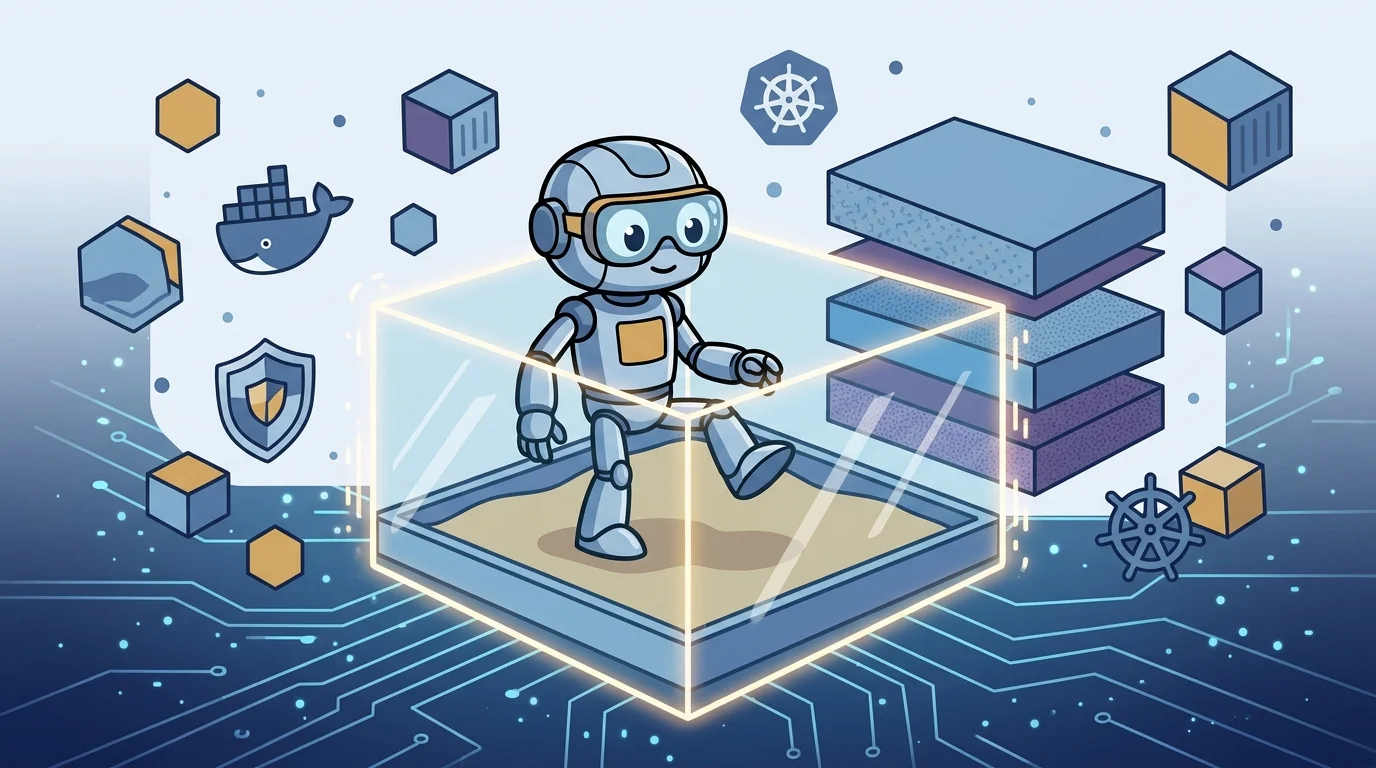
What OpenSandbox Is
Alibaba has published OpenSandbox on GitHub as a general-purpose sandbox platform built for AI applications [1]. The project targets teams running coding agents, GUI agents, agent evaluation pipelines, AI code execution, and reinforcement learning training workloads. OpenSandbox has been accepted into the CNCF Landscape, signaling alignment with cloud-native infrastructure standards [1].
Core Architecture and Components
OpenSandbox is organized around four primary building blocks [1].
The first is a set of multi-language SDKs covering Python, Java and Kotlin, JavaScript and TypeScript, C# and .NET, and Go. Installation follows standard package manager conventions: pip install opensandbox for Python, npm install @alibaba-group/opensandbox for JavaScript and TypeScript, and go get github.com/alibaba/OpenSandbox/sdks/sandbox/go for Go [1].
The second component is the Sandbox Protocol, which defines lifecycle management APIs and execution APIs. Because the protocol is designed to be extensible, teams can implement custom sandbox runtimes on top of it without being locked into the built-in options [1].
The third component is the Sandbox Runtime itself, which handles lifecycle management and supports both Docker and a high-performance Kubernetes runtime. This layer enables workloads to run locally or to be scheduled across large distributed clusters [1].
The fourth component is the collection of built-in Sandbox Environments. These include Command, Filesystem, and Code Interpreter implementations, along with reference examples for coding agents such as Anthropic Claude Code, browser automation via Chrome and Playwright, and desktop environments using VNC and VS Code [1].
A terminal CLI tool called osb is also provided. It covers common sandbox workflows including creating sandboxes, running commands, moving files, inspecting diagnostics, and managing runtime egress policy. It can be installed via pip install opensandbox-cli or through the uv tool installer [1].
Isolation and Security Model
OpenSandbox enforces workload isolation through support for three secure container runtimes: gVisor, Kata Containers, and Firecracker microVM [1]. Each option provides a different mechanism for separating sandbox workloads from the host, and teams can select the runtime that matches their threat model and performance requirements.
On the networking side, OpenSandbox includes a unified Ingress Gateway with multiple routing strategies. Per-sandbox egress controls allow operators to restrict outbound network access at the individual sandbox level, which is relevant for coding agent deployments where untrusted code may attempt external connections [1].
Supported Runtimes and Deployment Modes
The Sandbox Runtime layer supports Docker for local development and testing scenarios, as well as a Kubernetes runtime described as high-performance for production and large-scale distributed scheduling [1]. This dual-mode approach allows engineering teams to develop and validate sandbox configurations locally before promoting them to cluster-scale deployments without changing the SDK interface.
Target Use Cases
OpenSandbox explicitly names several production scenarios it is designed to address [1]. Coding agents, with Anthropic Claude Code cited as an example, represent one primary use case. Browser automation workloads using Chrome and Playwright constitute a second category. Desktop environment scenarios, supported through VNC and VS Code integrations, form a third. AI code execution and reinforcement learning training round out the listed targets.
The breadth of these use cases reflects the platform’s positioning as a shared infrastructure layer rather than a tool purpose-built for a single agent type. Teams operating multiple agent types within the same organization could, in principle, standardize on a single sandbox runtime rather than maintaining separate isolation solutions for each workload.
FAQ
Q. Which programming languages are supported by the OpenSandbox SDK? OpenSandbox provides SDKs for Python, Java and Kotlin, JavaScript and TypeScript, C# and .NET, and Go [1]. Each SDK is distributed through its respective language ecosystem package manager.
Q. Can OpenSandbox run without a Kubernetes cluster? Yes. The Sandbox Runtime supports Docker for local execution in addition to the Kubernetes runtime [1]. This allows developers to run sandboxes on a single machine before deploying to a distributed environment.
Q. What isolation options are available, and how does a team choose between them? OpenSandbox supports gVisor, Kata Containers, and Firecracker microVM as secure container runtimes [1]. The project documentation refers to a Secure Container Runtime Guide for selection guidance, though the specific trade-offs between the three options are not detailed in the available source material.
Q. Is the Sandbox Protocol extensible for custom runtimes? The Sandbox Protocol is explicitly designed to allow teams to extend it with custom sandbox runtimes [1]. The protocol defines both lifecycle management APIs and execution APIs as the extension surface.
Q. How is egress network traffic controlled per sandbox?
OpenSandbox provides per-sandbox egress controls alongside a unified Ingress Gateway with multiple routing strategies [1]. The osb CLI also includes commands for managing runtime egress policy at the sandbox level.
Key Takeaways
- OpenSandbox is an open-source, general-purpose sandbox runtime from Alibaba, now listed in the CNCF Landscape, targeting AI agent and RL training workloads [1].
- The platform offers multi-language SDKs (Python, Java/Kotlin, JavaScript/TypeScript, C#/.NET, Go) and a standardized Sandbox Protocol that supports custom runtime extensions [1].
- Strong isolation is enforced through gVisor, Kata Containers, and Firecracker microVM, with per-sandbox egress controls for network policy [1].
- Docker and Kubernetes runtimes are both supported, enabling a local-to-distributed deployment path without SDK changes [1].
- Built-in environments cover coding agents (including Anthropic Claude Code), browser automation, desktop environments, AI code execution, and reinforcement learning training [1].